A Wedding in Bilbao

Weddings are much anticipated, joyous occasions. These nuptials were that and much more. Propelled by love and political expediency, bride and groom hoped to bring peace to a troubled region. This vignette is your invitation to a front-row view of this momentous event, which comes from Chapter 12 of Gypsy Spy, “Dead or Alive?”

The cars rode in proud procession through the streets of Bilbao. Some of its citizens lined the streets out of respect. Others hid at home out of fear. A few looked on out of curiosity. Fewer still were planted strategically in the crowd to keep the peace. Members of the Herri Batasuna, the People’s Unity Party, filled the limousines. Today would mark a glorious triumph, a master stroke of political ceremony. One of their own, a colonel in the renowned Euzkadi Ta Azkatasuma, the ETA, was marrying a Borbón. A minor Borbón, to be sure, but royalty nonetheless. It would not give them independence. It would not bring them immediate peace. But it would offer them leverage where none had existed before. Their political force would be brought out into the open, more in the public eye.

The entourage arrived at the cathedral without incident. A local police contingency that was staunchly loyal to Madrid kept a respectful, but watchful, distance. Car doors snapped open. Soldiers of the Basque liberation poured out and stood guard in front of the church. Party members followed and entered the cathedral, forming a protective phalanx for Colonel Alvarez Colón Zamora; Basque patriot, separatist, warrior, terrorist, murderer, sheep herder. Their man of the hour. He stepped out of his limousine and walked slowly into the church, thankfully accepting his destiny. He was no longer a young man. He now had a chance at not only a second family with children of his own to rear, but also an opportunity to bring lasting justice to his people.

Not long after, a smaller cavalcade made its way to the church. Upon arrival, Spanish soldiers poured out of the sedans and took up positions similar to those occupied by the Basque guards. The bride, dressed in an elaborate white wedding gown with more layers of lace than solid material, and her family stepped up to the cathedral doors. The young woman looked at the ornately carved door through her white veil and breathed deeply. Her wedding may be unorthodox, but it offered her cousin, King Juan Carlos I, a hope for a united Spain. It also gave her a chance to consummate her love for a man she knew foremost as a gentle father and simple shepherd.

Her father pulled her back away from the doors and her bridesmaids filed past. She felt, rather than heard, the pipe organ kick into action. Its deep notes rumbled in her chest and did little to settle her heart. Her father offered his left elbow and she grabbed hold with her gloved hand, clinging to it for strength. On shaky legs, the girl of eighteen and her father began their walk down the aisle. She was surprised by the number of people in the church. The closer she got to Alvarez, the faster her heart pounded. He smiled at her, dimples appearing on his leathered cheeks. His stocky frame seemed to want to burst out of his tuxedo. She could almost smell his virility. Tonight will be a memorable one, she told herself.

He answered the priest’s questions by rote, his eyes never wavering from the face of a child he had grown to love. Her father used to bring her with him when he purchased sheep from Alvarez. At that time, even though his first wife was still alive, he had felt a strong attraction to the young teenager. Maria had been more than sympathetic toward him after his wife’s death. Their love had grown. Today it would be sanctioned by God and the King. Not that Alvarez had ever let their disapproval impede his endeavors. Their candle lighting finished, their vows complete, he lifted her veil and kissed her tender young lips. Neither of them could wait to get to their honeymoon cabin in the Pyrenees.

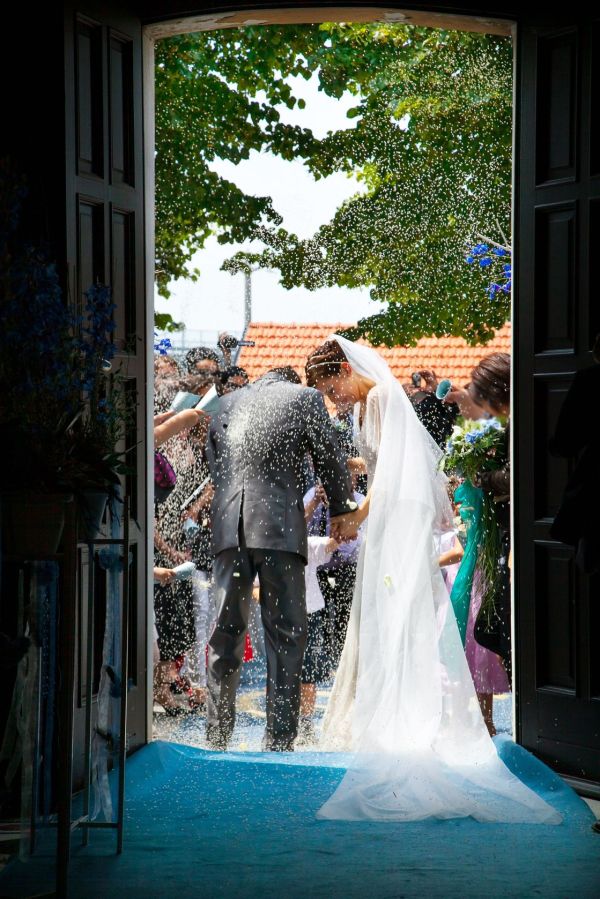
With the approving witnesses cheering them on, they walked out of the church. The sun was unbearably bright after the dimness of the cathedral. Just when Alvarez grew accustomed to the light, the rice began to fall. He blinked against the grainy onslaught and saw a face in the crowd. He looked harder and smiled, his heart bursting with joy. Then the rice began to sting unbearably. He kept his hand before his face in an attempt to protect it while keeping an eye on the figure he had spotted. But his hand, and then his arm, did not provide adequate protection. The rice continued to fall in a stinging barrage.

Maria felt a strong pull on her arm. She tried hard to keep her balance, but lost. Bride and groom tumbled down the last half of the stairway and landed in a heap on the sidewalk in front of their waiting limousine. Soldiers of the Basque liberation rushed forward. Policemen kept the groaning crowd back. By the time Alvarezes’ guards reached them, Maria was on her knees and screaming hysterically. They soon saw why. Alvarez’s face was swollen, disfigured beyond recognition. His eyes were bulged and rolled back with only the whites showing.

Three of his trusted brothers-in-arms tried to hold him down in an attempt to control his convulsions. One had the mind to scream for a doctor, but it was no use. Alvarez spasmed once more and lay still. One of the guards took off his jacket and laid it over the groom’s face.

Maria Elena Borbón y Castillo de Colón, member of the royal family, supreme optimist for peace, lover of a shepherd, married at eighteen, was now a widow five minutes after the ceremony. In her shock, all she could think of was that she looked awful in black. “Está muerto, está muerto,” someone in the crowd nearest to the scene began to cry. The police and Spanish soldiers, despite their feelings for a “known” terrorist, contained and detained the crowd. Cause of death and possibility of foul play had to be determined. None would be allowed to leave the church steps until some questions had been answered.

But some had already left without permission, taking with them a few wallets, purses, watches, bracelets, and rings that they hadn’t brought with them.

“Would you slow down?” Diego asked. They had already traveled twelve blocks at a fast trot. Carlos showed no signs of slowing his pace. Diego felt compelled to grab hold of the other boy. If they continued running, he thought, they were sure to be stopped. Carlos spun on him, fist raised, eyes panicked wide. Diego ducked the oncoming blow and pushed them both into a wall. “Javier, it’s me. We can’t keep running,” Diego said, holding the boy to the wall, waiting to see reason return to his friend’s face.

“We need to get out of the open,” Carlos said.

“Come on, follow me,” Diego turned them off the broad avenue and into the tight streets of an ancient neighborhood. He took them straight to a lot which a year before had contained a dilapidated building. The city developers had knocked down the hazard, but had not filled in the basement storage units. The boys clambered through the debris into the ground. They sat in the darkness, the sound of their breathing filling the air about them.

“Do you have a cigarette?” Carlos asked. Diego shook one out in the direction of the voice and felt the cigarette slide out of the pack. They both lit up. In the flash of light and the glow of the cigarette, Diego could see the tear tracks on Javier’s cheeks. But his eyes now looked vacant, the irises a cold steel.

“Did the man’s death frighten you?” Diego asked. Carlos’s cigarette burned brighter as he inhaled the smoke. He wouldn’t look Diego in the face.

“No,” Carlos said rubbing his eyes. Diego leaned forward to get a better look at him.

“Did you have something to do with that man’s death?” Diego asked.

“I had everything to do with his death.” Carlos could still hear the woman’s screaming, could still see Alvarez’s stare.

“You mean . . .”

“I killed him,” Carlos said, cutting him off. He tossed his cigarette on the floor and stomped it out, becoming a shadow in the dark. Diego took a long time to comment.

“Why?”

“I thought I had a good reason. I’m not sure now.”

“What was your reason?”

“In the apartment in Barcelona, I found my father’s files.”

“The suitcase?”

“Yes, the suitcase. I’ve been studying them for the past two weeks. Whoever killed my father took my life also. I want to find them. In order to find them, I must make them believe that my father is still alive.”

“And your father had planned on killing this man?”

“Yes.”

“Why?” The question hung in the air. Carlos searched deep for a moral answer. The man was a terrorist, a threat to Spain. Alvarez had killed plenty himself. His time was up. Justice had to be served. But the truth forced itself past his lips.

“For money,” he said.

“And you had a problem with begging,” Diego said. Carlos saw the boy’s smile. The world is an insane place, he thought as Diego’s grin caught on to his own face. “Can we go home now? My father will have our hides.”

“We’ve only been gone two days. Besides, we told him we were going on an excursion.”

“I know. But he fully expected us to stay in the area. Alfonso will be coming tomorrow.”

“That is what your father told me two weeks ago. Tomorrow never comes.”

“It comes,” Diego said. “But Gypsies get to determine when.”


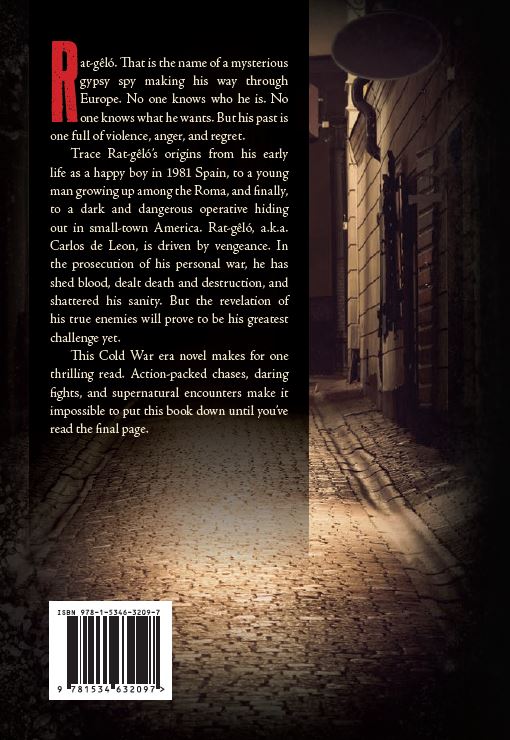
Gypsy Spy: The Cold War Files is now available on Amazon! Click here to go to the book’s page.


The Gestation of Gypsy Spy

Some people live under the adage “Publish or Perish!” I live with the reality of “write or wilt.” I have had seasons in my life when I have wandered from the discipline of writing – or at least the craft of creative writing. But whenever I have returned to it, I am immediately reminded that without it, I am a paler shade of myself. Running out of ink in my pen is more frustrating to me than running out of gas in my car. I can walk without gas. I’ve been tempted to draw blood when the inkwells ran dry.

Were it not for my brother John, I don’t know that I would have ever thought to write a spy story. When I was a newly minted teenager, he prodded me to expand my reading horizons beyond the science fiction and fantasy books that were the mainstays of my fiction diet. In my seventeenth year, he gave me a paperback copy of Robert Ludlum’s The Bourne Identity. I would remain a Ludlum fan for years to follow along with Follett, Morrell, Van Lustbader, and Travanian.

It was in July of 1983, while living in Fayetteville, Arkansas, that I typed out the first outline that would become Gypsy Spy. Originally conceptualized as El Gitano – Spanish for “the gypsy” – it was a mere five pages of character descriptions and chapter plot points. The following month, I moved to Richmond, Virginia to do college campus evangelistic outreach. I met my future wife that year. Ministry, work, and marriage kept me occupied. The story remained in the incubator of my mind, but the demands of my Bible teaching schedule and the poems for my bride got most of my writing attention.

Two years into our marriage, I decided to get serious about fleshing the story out. I began reading about the gitanos in Spain and Gypsy culture in general. I filled small steno pads with copious research notes and story ideas. In February of 1988, I grabbed a legal-sized note pad and my trusty Cross mechanical pencil (another boon from brother John) and started writing. I love to type, but I reasoned that if I wrote it by hand it would slow me down some and allow me to think more about what I was putting on paper. Also, I could carry the notepad and pencil wherever I went. And carry it I did: to jobsites, waiting rooms, dinner tables, road trips, house sitting assignments, and anywhere else I had been formerly accustomed to carry a book and read. I would eventually fill nearly twelve notepads – six hundred and sixty-seven pages – with the narrative ark of one Carlos Javier de Leon Velveloz, a.k.a. Rat-gêló. It took me three years. Then the real work began.

I started the first major rewrite in March of 1991. We had purchased an Amiga 3000 for our business and I picked up a Word Perfect® package to go along with it. I would lug the computer home on the weekends and sequester myself in my home office to transcribe and rewrite away to my heart’s desire. Writing is about writing, not about having written. The medium is always fluid, subject to change and in need of improvement. When I got to the last double-spaced, typed page – number 1,052 to be exact – two more years had gone by. Then the tax man came.

At the time, it ranked as one of the most devastating days I had ever experienced. I’ve had much worse since. But this day is still a hall-of-famer. I finally had a novel I could market. I did my research, wrote my pitch letters to publishers, dealt with silence and rejection. But ultimately, I got a solid line on a reputable agent in New York City and an offer from a real publishing house out West. On the day the tax man came, my ongoing negotiations with the publisher came to an end. We weren’t seeing eye-to-eye and in my frustration I told them to forget the whole deal and to send me the manuscript back. Shortly thereafter, I received a call from the agent. She was very encouraging and complimentary, but in the end she didn’t feel like we were a fit. No publishing contact, no literary agent and moments after hanging up from the phone call from New York, the IRS came into our office and threatened to shut us down. I went home and cried like a baby.

After drying off my wife’s shoulder and taking stock of all the blessings I had in her and our children, I rolled up my sleeves and knuckled down for the hard work ahead. Nearly twenty years would go by before I worked on the novel again.

While packing for our impending move last spring, I came across the floppy drives that housed the electronic copy of the novel. I asked my friend Aland if he could transition the text into an MS Word® file for me and put it on a thumb drive. He did me more than one better. He produced a Word document, a pdf, and he read it. In the middle of a literary conversation months later, he mentioned that he had quite enjoyed my story and encouraged me to investigate putting it out as an e-book on Amazon. His encouragement led me to the latest rewrite.

As I worked through the story again, I was very thankful that I didn’t manage to get it published in 1994. I was younger then with twenty less years of life experience and writing practice. The novel that got bound in 2016 is a much better story than the manuscript I marketed in the 1990s. Additionally, Romani language helps that were not available when I first wrote it are now much more accessible. Gypsy culture is opening up to the gazhikano world like never before in history. They are making their oral language known in written form. This has allowed me to standardize the Romani words, expressions, and proverbs that are salted throughout the story with much improved results.

To date, I’ve gone through three galley proofs of the novel. I think their spines look quite handsome and am looking forward to revealing the front cover soon. But beyond that, I am very pleased to finally be able to share Rat-gêló’s story of redemption with the reading public in true book form. The title will be available soon on Amazon. Follow the blog for updates, insights, and more back story.

The Berlin Wall

Nothing else symbolized the stark struggle of the Cold War quite like the Berlin Wall. As a young American expat living in Spain in the early 1970s, I lived with constant reminders and vestiges of 1940s Europe coupled with the realities of the West’s struggles with Communism. Socialists of a different stripe, the Fascist regime of Franco was no fonder of the Soviets than we were.

I remember one particular morning when the mechanic on our street called me into his shop. An American serviceman was there with his family. Their car had broken down and the mechanic needed an interpreter. Sadly, I wasn’t much help as I had lost most of my functional use of English by then. I called one of my siblings over and our families soon became fast friends. The father of the family was a U.S. Army serviceman stationed in Frankfurt. His wife was German. At fourteen, she had made her way out of East Berlin across the death strip with her mother. The Wall wasn’t a news story to me. It was malevolent and real.

Standing at the Brandenburg Gate on June 12, 1987, President Ronald Reagan issued a clear challenge to Mikhail Gorbachev, the head of the Soviet State. “Mr. Gorbachev, open this gate! Mr. Gorbachev, tear down this wall!” As Reagan predicted it would, the Wall fell in the face of faith, truth, and freedom.

A Cold War story would be incomplete without an attempted defection under the shadow of the Wall. Submitted for your enjoyment is Chapter 3 of Gypsy Spy, “Defection”.

Defection
Victor Bendercoff had converted the bottom floor of an abandoned building into an interrogation post and holding cell. He liked gleaning information from his “detainees” outside of the hearing walls and halls of the Kremlin. Not only was he able to keep some information as bargaining chips for himself, he was also able to intimidate his captives better in the primitive surroundings of the long unused edifice. Today’s catch would be most rewarding.

He had had Yuri Velhoussen under surveillance by request of his superiors for the past four months. At his insistence, they had given him clearance to information on the project Dr. Velhoussen had been directing in Prague. The information was frightening. If he had been successful in defecting to the West, it would have marked the end of the Soviet Union as a superpower. His superiors held the suspicion that Velhoussen had developed a more powerful weapon privately than the one he had manufactured under government supervision in the secret basement labs of the University. His first goal in the job had been achieved. He had, on a tip, found Velhoussen in East Berlin. He had also been able to capture the Western agent who was leading him over to the other side. His superiors would enjoy making a media circus of the man after all the interrogations were complete.

Victor kept the detention van in his rearview mirror as he turned into the short driveway that had been cut into the cracked sidewalk. With his remote control, he opened the wide, louvered door which led into his special small-scale, high-security prison. He hit the remote control again when he saw that the van was all the way in the building. He parked his sedan and got out. His two guards in the van got out and headed to the rear of the vehicle. Immediately, he heard loud obscenities. He ran over to them to see what the matter was. Propped up in the padded cube was Professor Yuri Velhoussen, renowned physicist, his chest awash in blood. There was no sign of their other captive. The charred metal around where the door latch used to be told its tale.

“How?” his man asked, eyes wide open and jaw slack. Victor kicked the door shut. His anger not satisfied, he punched the driver knocking him to the floor.

“It doesn’t look good for either of you,” Victor said.


Charles Drake waited for a full hour past the rendezvous time. He lit a cigarette and decided to wait a little longer. If this defection went well, they wouldn’t have to be concerned over the unification of Europe. But it was already obvious something had gone wrong. He had hand-picked the guide for this mission. The papers had been falsified by one of the best counterfeiters “recruited” by the Secret Service. They had poured over the details of this plan for months prior to the operation. A half-hour and three cigarettes later, Drake walked away from the Wall in disgust.

Once back at the embassy, he checked his coded messages file. A single sheet lay inside. He deciphered the text and read, “Phoenix, Blackhawk. Code Red. Outcome Blue/Black. Coordinate Schedule C.” Code Red: his guide had been intercepted. Outcome Blue/Black: the defector had been captured and killed. Coordinate Schedule C: they would meet in two days at a bar in Bonn. Drake sighed heavily. Why had they killed him? Had reports of the sun filter been exaggerated? Did the Soviets not need the scientist? Had he tried to resist capture? Had the Leoppard struck?

He picked up his red phone. He dialed the number. After four rings someone picked up. “Secure line,” he said.

“Secure line,” a voice replied.

“Set Operation Tiger fully active.”

“The buttons are set.”

“We can’t miss this time.”

“We won’t. The piece falls this time.” On that assurance, Drake hung up. He reached into his desk drawer and pulled out a pint of whiskey. He gulped a heavy shot and leaned back into his chair. The piece better fall this time, he thought, or God help us all.

Every Hero’s Sidekick

It takes two to tangle. Robin Hood had Will. Tom hung with Huck. Butch rode with Sundance. Don Quixote and Sancho, Ibn Fahdlan and Herger, Alatriste and Íñigo, Paul Atreides and Duncan Idaho – these friendships are epic. Carlos de Leon has Diego. Following are a couple vignettes of their growing friendship from Chapter 8, Among Family.

In the Park
Diego led them into the milling crowd. They made a circuit about the whole area before he chose his spot. Under the shade of a modest fountain, he knelt on the cobblestones. He extracted a rolled newspaper from his back pocket and laid it out before him. He then repositioned himself onto the newspaper. How it was accomplished, Carlos did not know. But kneeling on the cobblestones, Diego appeared to have been amputated just above the knees. His scene set, Diego began to beg. Carlos stayed close but tried to appear unconnected.

Diego remained in his spot for two hours. By that time, he had collected a hefty sum of pity plus change. Carlos observed that he was careful to gather all his money, scoot back off the newspaper, roll it up and then stand. He supposed, and rightly so, that it would not have appeared correct if an obviously healthy boy were to be seen gathering offerings off the paper.

“What do you think?” Diego asked him, shaking the strain out of his bound legs.

“How did you do it?”

“Practice,” Diego answered with a smile. “There are other ways to beg, though. Look pitiful enough and you won’t have to appear handicapped.”

“I’m not sure I follow,” Carlos said.

“You know, put on a sad face. Put on the mask of the destitute and extend your hand.”

“You mean, like this?” Carlos said, putting on what he considered his most pitiful face and extending his hand. Before he could retract his demonstration, someone dropped a coin into his hand.

“Yes, like that,” Diego said. Carlos was startled. He could never remember Jane giving money to beggars on any of their excursions. He could remember her telling him not to encourage their way of life by giving them what they asked for. “If they want money, they can work for it,” she had said. He had wondered then whether or not truly destitute people existed. And if they did, didn’t they deserve, if only because of human kindness, any handout they received? To beg when one could work was immoral, he reasoned. He dropped the change on the ground and informed Diego of his opinion.

“You wish to work for your money?” the other boy said as he picked the change off the ground. “You haven’t known work until you’ve begged all day.”

“I’m serious, Diego. You took the pity and hard-earned money of people by deceit. That money could have gone to someone who really needs it.”

“Believe me, I need it and my family needs it,” said Diego in a serious tone. “You simply do not understand our life. But if you insist on working for your money, follow me. I have a job for us.” With a straight back and the first purposeful stride Carlos had seen him exhibit, Diego led them out of the plaza and headed west…

…“Are you an orphan?”

“Yes,” Carlos answered softly.

“An orphan who cannot go to the authorities for help must survive by his own wits. Are you still convinced that our way is immoral?”

“I thought you brought me here to work for my money.”

“I did. I need you to distract someone while I pick his pockets.”

“This is your idea of work?”

“Believe me, it is no easy task.” Carlos considered Diego’s suggestion. He finally reasoned that he couldn’t get into any more trouble than he was already in. What was begging or picking pockets once you’ve killed someone?

“Do we have to go into the station?”

“No, we can do it from the park. We can wait behind the bushes you were standing near earlier. When a good mark comes along, I will point him out. When he gets into the park, put yourself in his path and beg. If he pays you no heed, then you become very obnoxious and demanding. While he is dealing with you, I’ll take what I can find. Sound good?”

“What if he pays me heed?”

“So much the better. We’ll get his money freely. Then we will pick another mark. What do you think?”

“Let’s get on with it,” said Carlos, feeling resigned to his fate of an outlaw.

“Travelers usually carry a fair amount of cash with them,” Diego explained as they sat on the ground, hidden from view of the station by the boxwoods. “Look at that one,” he exclaimed in a whisper.

“The lady with the big hat?” Carlos asked.

“No, behind her and to the left coming this way. The man in the brown suit,” Diego said, pointing. Carlos looked in the direction his friend had indicated. A short, stout man was crossing the street. His suit was a dark brown and appeared to be silk. The sun glinted off his highly polished, pointed brown boots. He was impeccably dressed and his hair seemed groomed by a salon. Not one black lock moved out of place as a breeze gently swayed the leaves in the trees above. It stayed combed back and flat on his round head. “See that briefcase? Snakeskin,” Diego breathed. “And look at the rings he is wearing. Looks like our mark.”

“Where do I go?” Carlos asked, getting excited in spite of himself.

“Wait until we see where he enters the park. We’ll follow him in for a little while. Then you can break off and get ahead.”

They waited, holding their breaths. The man came in on the sidewalk to their right. His stride was fast and full of purpose. Diego waited a few seconds and rose. The boys headed out after their quarry.

A quarter of the way into the park, Diego gave Carlos a little nudge. The boy headed off into the trees on the left and silently ran ahead. He came out onto the cobblestone walkway about a hundred yards ahead of the businessman. He put his back to a tree, stuck out his hand, and waited. The man walked within a foot of him and didn’t even spare him a glance. Carlos felt suddenly indignant. Once more, he ran ahead of the man, this time in the open. He planted himself in the businessman’s way.

“Please, sir, I am an orphan. Just a little money, please,” Carlos said, genuinely feeling his plight. The man sidestepped him. Carlos matched his pace, increased it, and got in front of the man once more. He almost walked over him when Carlos stopped. “Help a needy child,” Carlos pleaded.

“Get out of my way and get a job,” the man said contemptuously. Behind the man, Carlos could see Diego only two steps away and running. His mind screamed “No!” Diego came in low and made a snatch at the briefcase being held in the man’s left hand. Carlos was too startled by Diego’s bold action to act immediately. The move didn’t faze the businessman for a second. His right hand came out of his suit pocket and made a slash at Carlos’s left shoulder. Five inches of menacing steel passed under his eyes.

Even as his mind became a detached observer, his extensive training took control of his body. As the man made his back slash with the knife, Carlos caught the wrist with his right hand and twisted the arm. He stepped back, extending the man’s arm, and slammed his forearm into his opponent’s elbow and felt it give. He heard the switchblade clatter onto the cobblestone. He kept twisting on the arm while he pushed forward, grinding the joint.

Diego had failed in his attempted grasp. The man had pulled his arm back as Diego had grabbed it. Ignoring the pain in his right arm, he swung the heavy case in an arc over his back. He felt it collide with flesh. The blow caught Carlos in the head, making him let go of the man. He stood dazed for a second. His vision was blurred. He shook his head. The man was standing in front of him. His left foot, encased in a sharply pointed boot, was coming off the ground and heading for Carlos’s groin. Carlos blocked the kick with a downward swing of his right arm. Spinning on his right foot, Carlos swept the man’s remaining support with his left leg. As the man fell, Carlos delivered a backhand with his left fist to the bridge of his nose.

The man hit the cobblestone full force. His head bounced off the ground, then lay still. Diego grabbed the briefcase and ran. Carlos stared at the violence he had caused, transfixed. The man’s right arm was bent in an unnatural angle. His nose was flattened and oozed blood onto his pale face. He had accomplished this. It was his handiwork. He crouched over the man and felt a pulse in his neck. At least he is alive, Carlos thought thankfully. A whistling sound broke into his thoughts. He looked up and realized that he had a sizeable audience. Sensing his danger, he ran, plowing through two people who tried to stop him.

Within moments, he caught sight of Diego just as the boy darted into the trees. He increased his pace as best as he could on the small trail in an attempt to catch his friend. Diego broke out onto the street on the southern edge of the park. Carlos was close on his heels. Within a block, the boys were running side by side. Their young legs pumped for blocks. Carlos was beginning to feel light-headed. Sweat dripped from his brow into his eyes. He wiped his face with his left shoulder, but it did no good. His shirt was slick and wet. He shook his head to help clear his eyes. His legs were nonexistent. His lungs were on fire.

Diego dodged into an alley. Carlos followed suit. Halfway down, Diego stopped in front of a large, roll-up door. Diego bent down and managed to pull up the door high enough to allow then to crawl in. Squeezing in under the door, Carlos began to feel the pain in his left shoulder. He gritted his teeth in order not to cry out. Diego pushed the door down behind him and thus shut out all the light. The boys sat in the darkness and caught their breaths. “Come on,” Diego said a minute later.

A flash of light momentarily blinded Carlos. Its sudden appearance startled him. He closed his eyes loosely for a second and opened them again. The match flame was moving ahead of him. He rose and followed it tentatively. He noticed the downgrade of the pavement beneath him. He felt the presence of the concrete giants that were the supporting columns of the high-rise. Deeper under the earth they went. He caught up with Diego just as the other boy was making his way through a hole in the wall. Carlos followed him into the foundations of the next building.

In the Fog

I was born in coastal California, spent some very formative years on the Mediterranean coast of Spain, and have lived in coastal Virginia for the past twenty-seven years. There is no fog quite like sea fog! I loved taking walks with my father when I was a kid. He set the pattern early as I followed him on foot from Michigan to New York when I was six. These memories combined and went through the imagination filter. Some of the end results can bee seen in Chapter 1 of Gypsy Spy, “In the Fog.” Enjoy!

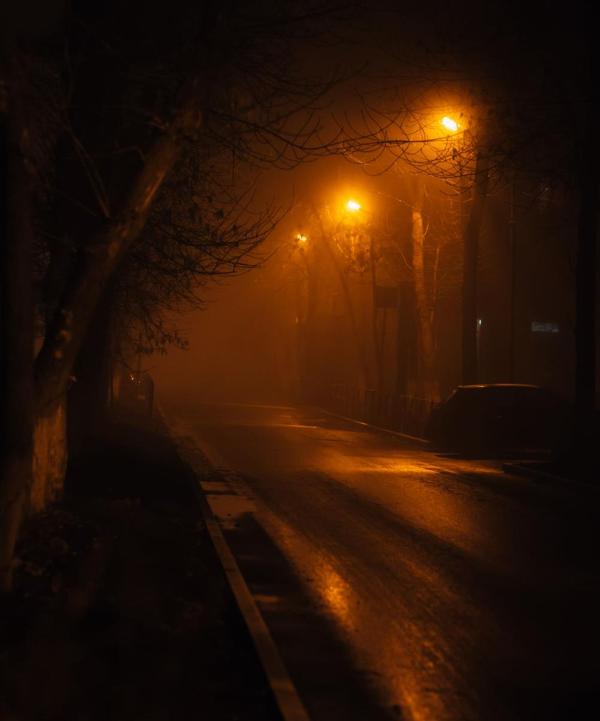
The sea fog swirled around him, momentarily revealing glimpses of the world he had left behind upon entering the milky wonderland. It exhilarated him. He was invisible, able to float through the streets unseen, unknown, unmolested. A smile broke upon his face and he could scarcely contain himself from running for joy. But he knew that he couldn’t stray far from the clicking heels of his father.

Were he older, he might have discerned that the comfort he felt didn’t come from the thick fog which came rolling off of the Mediterranean. Rather, it came from the fact that he was walking in it with his father. The warmth he felt was his father’s love. The safety which hugged round about him was brought about by his father’s watchful care. The joy which bubbled in his soul came from the sure knowledge that he was alone with his papa, encased in their private cocoon of alabaster.

“Do you have your marbles with you?” his father asked.

Si, papa.

“English, boy. English. You’ll need it one day.”

“Yes, father.”

“Better. Now, do you have your marbles with you?”

“Yes, sir. I only won ten yesterday. Nobody else wanted to play with me.”

“I imagine not, after a performance like that. I want you to do something for me, okay?”

“Anything,” said the boy, a smile in his voice. Do something for his father? The slightest opportunity to be of help to him made the boy ecstatic.

“Do you remember when we threw stones into the canal together?”

“Yes, you taught me how to hit the oranges that were floating in the water.”

“Exactly. I want you to do something similar this morning. I want you to keep walking in this direction. The instant you see a lamp post, I want you to try and hit it with one of your marbles, understand?”

“Hit the light?”

“No. Hit the post.”

“But won’t I lose the marbles if I throw them?” said the boy, a shadow crossing his brow at the strange request.

“Yes, you will lose them. I want you to throw and keep walking. With each one you see and hit, walk faster, understood?”

“But I won these marbles fairly,” he said, defending his treasure by placing protective hands over his bulging shorts’ pockets.

“I know you did. And I am sure you will win more,” his father reassured him, while looking nervously back over his shoulder.

“How can I win any more if I throw all the ones I have away?” asked the child, tenaciously trying to keep them in his possession.

“I’ll replace them,” said the father in an even voice, his jaw clenched tightly. “Now, will you do as I ask?”

“Is this another game?” asked the boy, defensiveness giving way to mirth.

“Yes. Can you do it as I described?”

“Sure. It’ll be fun. I go faster at each one?”

“Yes. Can you do it?”

Creo que puedo,” confessed the boy with confidence.

“Wonderful. Begin.”

Shane allowed the boy to slowly get ahead of him. He was three feet behind him when the first lamp post materialized within their swirling world of white. In the space of an eye-blink, he heard glass strike metal. His son’s pace increased. He kept his steady. A minute later he heard the sound before the street light came into view. He stopped at the pole and waited. A background hum had begun in the city. A sharp “tink” echoed briefly in the street followed by the sound of heels on concrete. He smiled. Right on time, he thought.

Extracting a cigarette, he resumed walking, now faster than before. Timing was crucial. He led his tail to the sound of impacting marbles, glass on metal. His heart rate increased. He removed his overcoat, reversed it to its off-white side, and donned it with the hood up. Within one lamp post of his son, he stopped, lit the cigarette, and inhaled deeply.

Glass on metal, the sound of sandaled feet breaking into a run. A few seconds later, a man broke into Shane’s field of vision running fast. Shane took a long drag on his cigarette, a casual observer obscured by the fog. As the man came up beside him, he flicked the burning stick with impossible accuracy into the man’s right eye. The man almost stumbled in his attempt to stop, spin, draw his pistol, and face his assailant.

Shane whipped out the belt of his coat wrapping it around the man’s extended right arm. He pulled himself into the man’s surprised embrace. In one fluid motion, he slammed his left elbow into the chaser’s solar plexus, yanked the gun arm down across his rising right thigh, and rolled his pursuer onto the ground. He grabbed the man’s wrist in both hands and twisted the arm violently, further injuring the broken elbow, while at the same time planting his right heel on the man’s throat to cut short any exclamation of pain. The gun clattered useless to the sidewalk. One final twist of the injured arm, and the man blacked out.

Shane took a deep breath and listened. Very distant now, glass on metal. Not much time, he thought. Quickly, he dragged the man up to the side of a building. He extracted a bottle of brandy from his coat pocket and emptied half its contents on the man’s chest. He placed the bottle in the man’s right hand and wrapped the unconscious fingers around its neck after unwinding the belt from around the wrist. Not very original, he conceded to himself, but it may appease the curious passerby for a while. Besides, once they did discover him to be out of his senses, it would be a while before they would check for injuries. Especially since the bottle was held by the damaged appendage. He reversed the raincoat back to its tweed side and ran to catch up with his son.

“I hit all fifteen of them,” said the boy proudly. He had waited for his father at the last lamp post. “Did I score well in this game, papa?”

“Very well, son.” The fog was thinning out, slowly burning away under the influence of a spring sun. As the first rays broke in on their world, Shane could see the glitter of powdered glass lying round about the lamp post. He looked up and saw that the light was still intact, then looked to his son in disbelief.

“I saved the biggest for last,” said the boy. Shane shook his head slowly. He extracted another cigarette from the pack, lit it, and inhaled deeply. He wrapped his arm around his seven-year-old son’s shoulders and commenced walking again. Very well, he thought, very well indeed.

A Writer’s Journey

Though my father was quite eloquent, it is to my mother that I owe the writer’s bug that has afflicted me most of my life. I recall a particular day when she was reciting to company her latest composition. The short tale, typed out double-spaced on her Olivetti Underwood mechanical typewriter, was full of drama and intrigue. A housewife was having a conversation that could be construed as a poignant plea with a paramour. Her husband mustn’t know. How shall we hide the evidence of the crime? If he finds out, he’ll kill you. You can’t do it again. As it turned out, the object of her melancholy affection was the family dog who had had the temerity to kill and eat one of their chickens. She had me hooked. I couldn’t have been much older than five.

We moved to Spain not long after. Major family correspondence soon took the form of audio tapes. My father was an audiophile and though we had sold or abandoned most of our worldly possessions in the move, he had his high-fidelity system shipped over as soon as we were settled. Among its components was a reel-to-reel tape recorder/player. We would sit in the living room of our flat as he narrated our latest adventures into the microphone as lively as if his audience were present. We then each took our turn recording our greetings and adding whatever commentary came to the mind of children. Mother may have planted the writer’s seed in my soul, but to my dad I owe my lifelong attempt to become as well versed in oratory and engaging in story telling as he always was.

As most people with older siblings know, we younger ones learn as much (if not more) from them as we ever did from our parents. As the youngest of seven, I was under constant tutelage. Reel-to-reel soon gave way to the convenience of cassettes. Not only were the tapes easier to handle, the recording platform was compact and portable. My brothers, sister, and I entertained ourselves for hours on end recording stories and sound effects for our own amusement. It was a living laboratory of creativity at play.

I was eleven when I first confessed my desire to be a writer. My sister – a more generous soul one would be hard pressed to find – no doubt knew of it long before that. She had spotted my affinity for all things writing years before. I have in mind a particular birthday, my eighth or ninth, when she bought me a cardstock fan folder filled with tools of the trade: spiral notebooks, pocket notepads, pens, pencils, and rulers to help keep my stories straight. Near the end of the fifth grade, now back in America and having grasped the basic workings of English under migratory duress along with the wonders of the school library, I was exposed to one of the greatest tools of discontentment known to man: the catalogue.

Catalogues can make the most contented soul acutely aware of material desires heretofore absent in the human heart. A fulfilled and happy person can suddenly turn into the downtrodden disadvantaged by pretty pictures and artful descriptions. I was not immune to its devices. This one in particular, distributed in our classroom, was filled with descriptions of books. Library or not, I needed to own some.

I sat on my sister’s bed and showed her all the books I would buy if only I had the money. She encouraged me to check off the appropriate boxes on the order form. After we tallied up the total, she handed me some of her hard-earned cash from her tip stash and sent me off to school a happy boy. It only stands to reason that it was to her that I first confessed my dream of being a writer. I already had a project in mind, a grand adventure story of storm-blown Vikings surviving in North America. Never wrote it, but I kept on dreaming.

At thirteen, I produced my first serious effort. It was a novella of sorts, a thirty-something paged science fiction/fantasy yarn I hammered out on Mom’s Olivetti with a fierceness that left my index fingers blistered as I jabbed the keys to strike ink on paper. I was in love. The machine chunked its drumbeats into our dining room table. As the type hammers slapped the paper, the platen marched left as language filled in to the right. Ding! Hit the carriage return and begin anew. It had a rhythm and tune no keyboard can approximate. Centering headlines required math, aligning paper took care. The fever of story was tempered by the necessities of form, line ends and paper changes creating unavoidable pauses for reflection.

By the time I walked into my ninth grade creative writing class, I was ambitiously expanding the bare bones of that story into a trilogy. Is it o.k. if I just write chapters of my novel into my composition notebook for the writing assignment requirements, I asked my teacher. She had no complaints, though she did dutifully supply her red-penned critiques. God bless her!

The following year, the love of verse and rhyme took hold and I fell into a feverish pool of poetry I would not soon come out of. I had a close friend who loved to play piano. He would come over to the house and make our upright sing while I typed away on the Olivetti working out my rhymes in an attempt to find reason. It was in that bohemian gestalt that the stirrings of the story that would become Gypsy Spy began. Character sketches, story outlines, false starts and stops sputtered forward and then stalled.

I moved. I married. We worked. We loved. We dreamed. I had a story, but I wasn’t writing. Encouragement can come from strange quarters. In my case, it came from Larry Donner, Billy Crystal’s character in the 1987 film Throw Momma from the Train. His portrayal of a blocked writer is brilliant. But it was his line, “a writer writes”, that stuck in my craw and eventually moved me forward.

Abandoning my typewriter, this one a sleek Smith Corona electric with a daisy wheel set in elegant Pica 10, for the more organic and portable pencil and paper, I filled page after page and legal pad after legal pad. The story emerged; the characters put on flesh and began to breathe. A young boy loses his father as Europe begins to shrug off the weight of the Superpowers. Gypsies beg and dance, bleed and spy.

Decades have gone by and the story has come of age. Gypsy Spy: The Cold War Files, now available on Amazon, is a major milestone in this writer’s journey. Look for sample chapters, vignettes, and more backstory in posts soon to follow. If you like what you read, share it with your friends. Comments are more than welcome.

Blog at WordPress.com.

Up ↑